Description
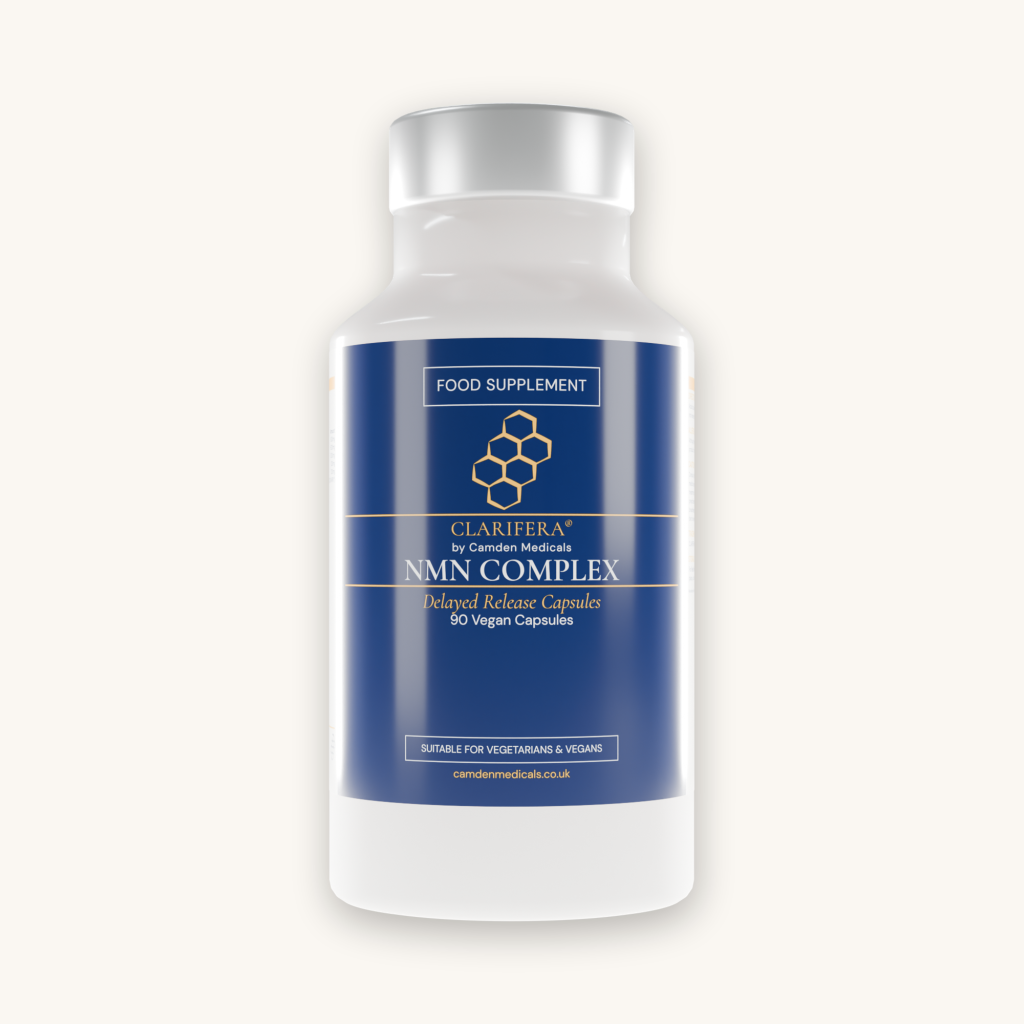
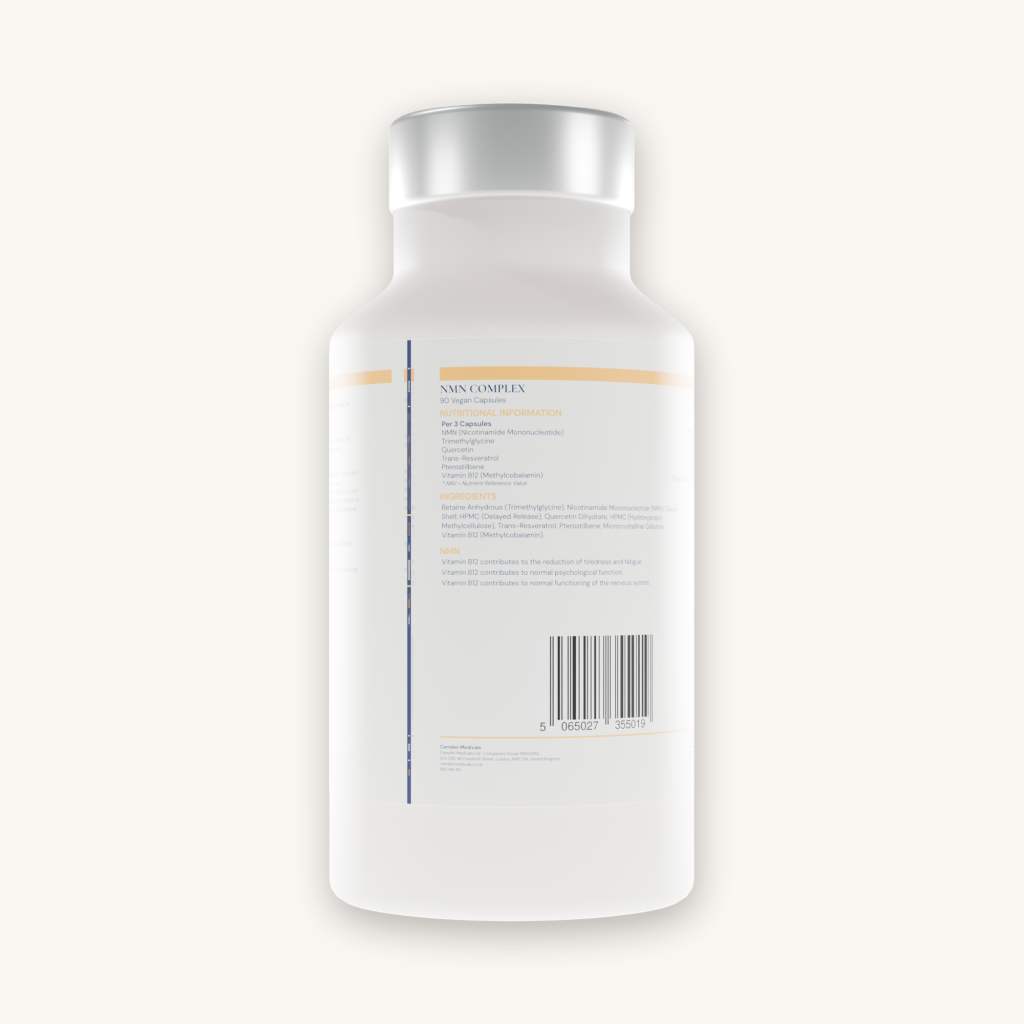
NMN Complex delivers a synergistic blend of six active compounds in HPMC delayed-release capsules for improved bioavailability. Every capsule provides NMN (Nicotinamide Mononucleotide), Trimethylglycine, Quercetin, Trans-Resveratrol, Pterostilbene and Vitamin B12 — a clean, once-a-day formulation.
Per 1-capsule serving
- NMN (Nicotinamide Mononucleotide) — 500mg
- Trimethylglycine — 600mg
- Quercetin — 300mg
- Trans-Resveratrol — 170mg
- Pterostilbene — 100mg
- Vitamin B12 (Methylcobalamin) — 150µg (6000% NRV)
EFSA-approved health claims (vitamins & minerals)
- Vitamin B12 contributes to the reduction of tiredness and fatigue, normal psychological function, normal functioning of the nervous system, normal energy-yielding metabolism, normal homocysteine metabolism, the normal function of the immune system, and normal red blood cell formation, and has a role in the process of cell division
Key features
- Six active ingredients in a single delayed-release capsule — one-a-day convenience
- HPMC delayed-release shell for improved bioavailability of sensitive compounds
- 90 capsules per bottle — 3-month supply at 1 capsule daily
- No artificial colours, flavours or preservatives
How to take: Adults, take one (1) capsule daily with food and water.
Manufactured in the United Kingdom to GMP standards.
About the ingredients
Methylcobalamin (active vitamin B12)
Methylcobalamin is the bioactive coenzyme form of vitamin B12 used in the cytoplasm for methionine synthase — the enzyme that recycles homocysteine to methionine in the methylation cycle. It is often marketed as the form that needs no conversion, but supplemental methylcobalamin undergoes the same intracellular processing as cyanocobalamin and, on current evidence, is unlikely to be advantageous over it. It is one of two bioactive coenzyme forms (the other is adenosylcobalamin, used in mitochondria); both are produced from dietary B12 in healthy adults with intact intrinsic-factor absorption. Vitamin B12 (the molecule) carries multiple authorised UK food-supplement health claims at ≥0.375 µg per serving — Camden NB-551 supplies 1000 µg. Read more in the encyclopaedia
NAD+ (Nicotinamide Adenine Dinucleotide)
NAD+ (nicotinamide adenine dinucleotide) is a coenzyme present in every living cell, central to energy metabolism and to several signalling pathways. It is not absorbed intact when taken by mouth. Products marketed as "NAD+ supplements" deliver one of several precursor molecules — niacin, nicotinamide, nicotinamide riboside (NR), or nicotinamide mononucleotide (NMN) — that the body converts to NAD+. These precursors have very different UK regulatory statuses, and the marketing claims around NAD-level marketing and age-reversal positioning are not authorised for use in UK food-supplement labelling. Read more in the encyclopaedia
NMN (β-Nicotinamide Mononucleotide)
NMN (β-nicotinamide mononucleotide) is a nucleotide the body uses to make NAD+, a coenzyme every cell needs for energy-producing reactions. The regulatory picture comes first here, because it governs what can and cannot be said about NMN: in Great Britain the FSA classifies NMN as a novel food that is not yet authorised, and there are no authorised UK health claims for it. In the EU, EFSA adopted a positive safety opinion in 2026 — judging up to 300 mg/day safe for adults other than during pregnancy and lactation, and assessing how well the body absorbs nicotinamide from NMN — but that is a safety and bioavailability opinion, not proof that NMN slows ageing or extends lifespan, and an EU authorisation decision is still pending. Beneath that authoritative guidance, our own reading of the trials is cautious: most of the lifespan and rejuvenation framing online sits well ahead of the human evidence. Read more in the encyclopaedia
Pterostilbene (trans-pterostilbene)
Pterostilbene (3,5-dimethoxy-4'-hydroxy-trans-stilbene) is a methylated analogue of resveratrol found in blueberries, grape leaves, and Pterocarpus heartwood. The two methoxy groups raise oral bioavailability to roughly 80% (vs ~20% for plain trans-resveratrol) and extend plasma half-life. Sold in the UK as a food supplement at 50–250 mg/day. NO UK food-supplement health claims are authorised. A small statistically-significant LDL cholesterol rise at 250 mg/day in a controlled trial complicates lifestyle-marketing positioning. Pregnancy: avoid supplemental forms. Read more in the encyclopaedia
Quercetin
In plain terms: quercetin is a natural plant compound (a flavonol, one of the flavonoids) found in everyday foods such as onions, capers, apples, berries, kale, and tea. It is sold in the UK as a food supplement at 250–1000 mg/day. UK and EU authorities have not authorised any health claim for it, and it does not appear on NHS or NICE treatment pathways — so it is a dietary supplement, not a medicine. It can interact with prescription medicines through CYP3A4 inhibition, and supplemental forms are best avoided in pregnancy (dietary intake from food is not the concern). Read more in the encyclopaedia
Resveratrol (trans-resveratrol)
Resveratrol (3,5,4'-trihydroxy-trans-stilbene) is a polyphenol found in grape skins, red wine, peanuts, and Japanese knotweed (the principal commercial supplement source). Trans-resveratrol is the bioactive isomer. Sold in the UK as a food supplement at 100–500 mg/day. EFSA did not substantiate resveratrol's cardiovascular claims; no UK food-supplement health claims are authorised. Drug interactions via CYP3A4 / CYP2C9 inhibition + antiplatelet activity. Pregnancy: avoid supplemental forms. Read more in the encyclopaedia
Trimethylglycine (TMG / Betaine anhydrous)
Trimethylglycine (TMG, also called betaine anhydrous) is an amino-acid derivative present in beetroot, spinach, whole grains, and seafood. It is the principal dietary methyl-group donor for the BHMT pathway, which lowers homocysteine. There is ONE authorised UK health claim — "Betaine contributes to normal homocysteine metabolism" — that requires a daily intake of 1.5 g of betaine to be made on a label. Read more in the encyclopaedia
Vitamin B12
Vitamin B12 (cobalamin) is a water-soluble B vitamin found almost exclusively in animal foods. The body uses it for red-blood-cell formation, normal nervous-system function, and energy metabolism. UK NHS reference intake is 1.5 µg/day for adults — small amounts, but absorption is intricate. Vegans, older adults with reduced stomach-acid production, and people on long-term metformin or proton-pump inhibitors are the populations most at risk of low levels. Read more in the encyclopaedia