Description
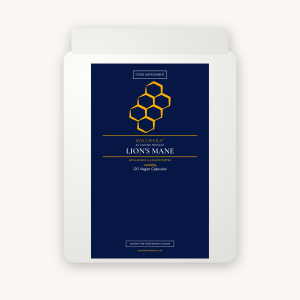
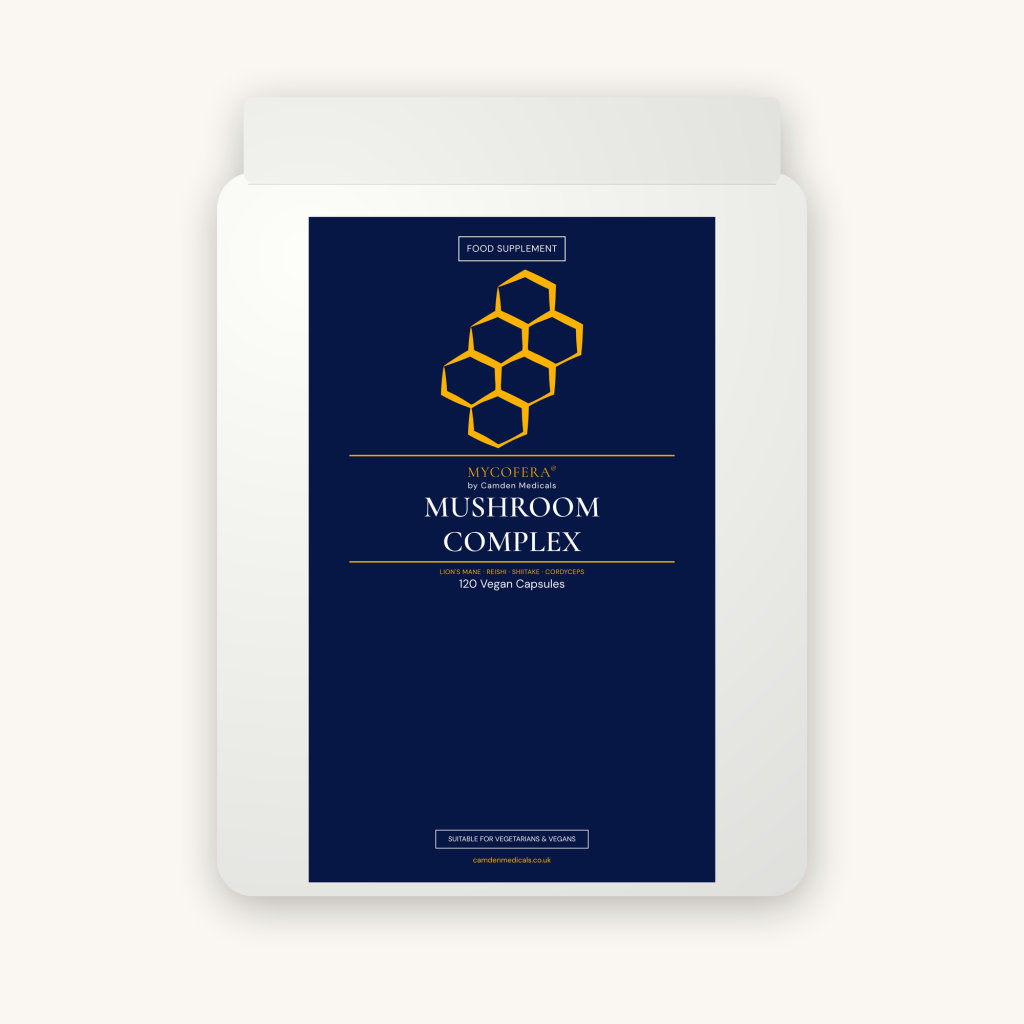
Mushroom Complex provides a blend of six mushroom powders — Maitake, Reishi, Shiitake, Lion’s Mane, Chaga and Cordyceps — enhanced with acerola cherry (natural vitamin C), turmeric root powder and black pepper powder. 100% vegan friendly with no added excipients or fillers.
Per 2-capsule serving
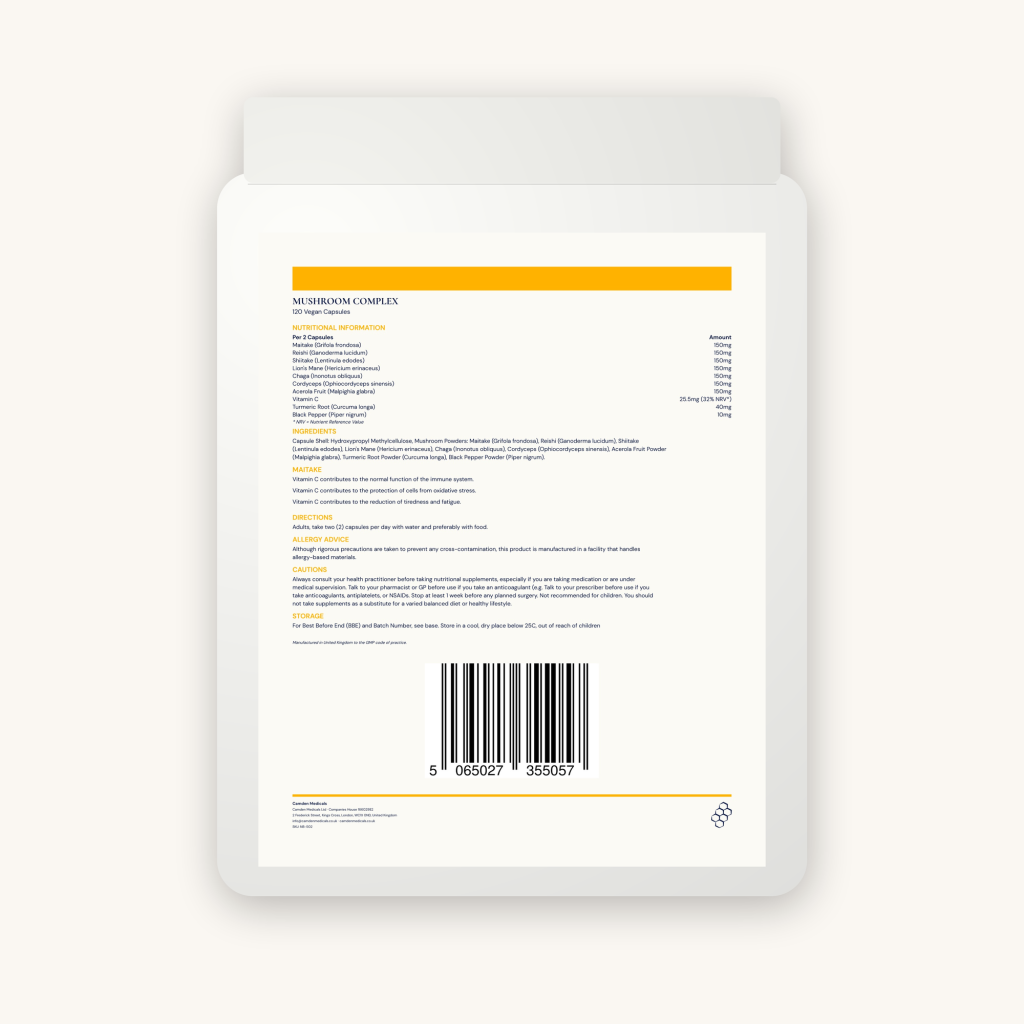
- Maitake (Grifola frondosa) — 150mg
- Reishi (Ganoderma lucidum) — 150mg
- Shiitake (Lentinula edodes) — 150mg
- Lion’s Mane (Hericium erinaceus) — 150mg
- Chaga (Inonotus obliquus) — 150mg
- Cordyceps (Ophiocordyceps sinensis) — 150mg
- Acerola Fruit (Malpighia glabra) (provides Vitamin C 25.5mg, 32% NRV) — 150mg
- Vitamin C — 25.5mg (32% NRV)
- Turmeric Root (Curcuma longa) — 40mg
- Black Pepper (Piper nigrum) — 10mg
EFSA-approved health claims (vitamins & minerals)
- Vitamin C contributes to the normal function of the immune system, the protection of cells from oxidative stress, the reduction of tiredness and fatigue, normal collagen formation for the normal function of blood vessels, bones, cartilage, gums, skin and teeth, normal functioning of the nervous system, normal psychological function, and the regeneration of the reduced form of vitamin E
- Other is Vitamin C increases iron absorption
Key features
- Six-mushroom blend in every capsule — a broad-spectrum profile
- Acerola cherry as a natural source of vitamin C
- 120 capsules per bottle — 2-month supply at 2 capsules daily
How to take: Adults, take two (2) capsules per day with water and preferably with food.
Manufactured in the United Kingdom to GMP standards.
About the ingredients
Acerola
Acerola (Malpighia glabra), also called the Barbados or West Indies cherry, is a small tropical fruit with one of the highest vitamin C contents of any food by weight. Acerola fruit powder is widely used in supplements as a natural source of vitamin C. Read more in the encyclopaedia
Black Pepper (Piper nigrum)
Black pepper (Piper nigrum) is a flowering vine of the Piperaceae family whose dried unripe berries are the world's most-traded spice. Piperine, the principal alkaloid, is the bioactive studied for its broad effects on drug-metabolising enzymes and intestinal absorption. There are no authorised UK food-supplement health claims for black pepper. Piperine-containing supplements can affect prescription-medicine handling — disclose use to your prescriber. Read more in the encyclopaedia
Chaga
Chaga (Inonotus obliquus) is a polypore fungus that grows as a black, cracked sterile conk on the trunks of birch trees in cold-temperate forests across Russia, Northern Europe, and North America. Used traditionally as a tea, increasingly available in UK supplements as fruit-body extract. The published human evidence is very limited; EFSA has not authorised any UK health claim. Two specific safety cautions apply: oxalate kidney-stone risk and theoretical bleeding risk. Read more in the encyclopaedia
Cordyceps
Cordyceps is a genus of parasitic ascomycete fungi traditionally used in Tibetan and Chinese medicine. The two commercial supplement species are Cordyceps sinensis (now formally Ophiocordyceps sinensis — the wild Tibetan caterpillar fungus, very expensive) and Cordyceps militaris (cultivated, the source of most modern UK supplements). Marketed primarily for energy and exercise performance; the published human evidence is limited and EFSA has not authorised any UK health claim. Read more in the encyclopaedia
Lion's Mane
Lion's Mane (Hericium erinaceus) is an edible white mushroom with a long history of culinary and traditional use, particularly across East Asia. It is sold in the UK as a food supplement. There are no authorised UK health claims for Lion's Mane — its EFSA evaluation for cognitive and nervous-system claims remains on hold. Read more in the encyclopaedia
Maitake (Grifola frondosa)
Maitake (Grifola frondosa, "Hen of the Woods") is a culinary-medicinal mushroom widely eaten in East Asia and sold in the UK as a food supplement, usually as dried fruiting-body powder or as a standardised polysaccharide extract. UK and EU authorities set the baseline here: there is no UK-authorised health claim for maitake (the Great Britain nutrition and health claims register lists none, and the EFSA Article 13 botanical claims for "natural defences"/immune health and for blood sugar remain on hold and unapproved), the NHS does not provide or endorse mushroom supplements, and Cancer Research UK states there is not enough evidence that maitake has anti-cancer or cancer-prevention effects. Beneath that authoritative layer, Camden's own reading of the primary literature adds nuance: the most studied preparation is the proprietary "D-fraction" (and the related MD-fraction), a beta-(1-6)/(1-3)-glucan proteoglycan from the fruiting body, and small early-phase trials in cancer-survivor populations have shown measurable but mixed immunological effects — the dose-response is non-monotonic, and "more is not better". Read more in the encyclopaedia
Reishi
Reishi (Ganoderma lingzhi, formerly Ganoderma lucidum in much commercial labelling) is a polypore mushroom with thousands of years of use in East Asian medicine. It is supplied in supplements as fruiting body, spore powder, or chemically extracted polysaccharide / triterpene fractions. The published human evidence is limited and EFSA has not authorised any UK health claim for it. Read more in the encyclopaedia
Shiitake (Lentinula edodes)
Shiitake (Lentinula edodes) is a culinary-medicinal mushroom widely eaten in East Asian cuisine and sold in the UK as a food supplement, usually as dried fruiting-body powder or as a beta-glucan extract. There are no UK-authorised health claims for shiitake — claims for "immune support" and "natural defences" are on the EFSA Article 13 botanical hold list and have not been approved. The molecule with the strongest pharmacological track record is lentinan, a beta-(1-3,1-6)-glucan, but published clinical use of lentinan is mainly as an intravenous chemotherapy adjunct in Japan — not as an oral food supplement. Oral shiitake supplementation has been studied in small short-duration trials, mostly with proprietary beta-glucan extracts; results show modest immunological biomarker changes rather than hard clinical outcomes. Read more in the encyclopaedia
Turmeric (Curcuma longa)
Turmeric is the bright-yellow root (rhizome) of the Curcuma longa plant — the same spice that colours curry. People take it mainly for joint pain, especially osteoarthritis of the knee. The part most studied is a family of plant compounds called curcuminoids (curcumin is the main one). There is no UK-authorised health claim for turmeric or curcumin, so a supplement label cannot lawfully make a treatment claim; this page describes the evidence and the official UK position without making a claim. The clearest practical point for a buyer: a "turmeric" capsule and a "95% curcumin extract" capsule are very different products, and curcumin on its own is poorly absorbed unless it is paired with black pepper (piperine) or sold in an absorption-enhanced form. Read more in the encyclopaedia
Vitamin C
Vitamin C (ascorbic acid) is a water-soluble vitamin the body uses for collagen synthesis, immune function, antioxidant protection of cells, and to help absorb iron from plant foods. UK NHS reference intake is 40 mg/day for adults. Most UK adults meeting the eat-five-a-day pattern cover this from food; supplementation is sensible for those who do not, and during specific situations like recovery or pregnancy. Read more in the encyclopaedia