

Description
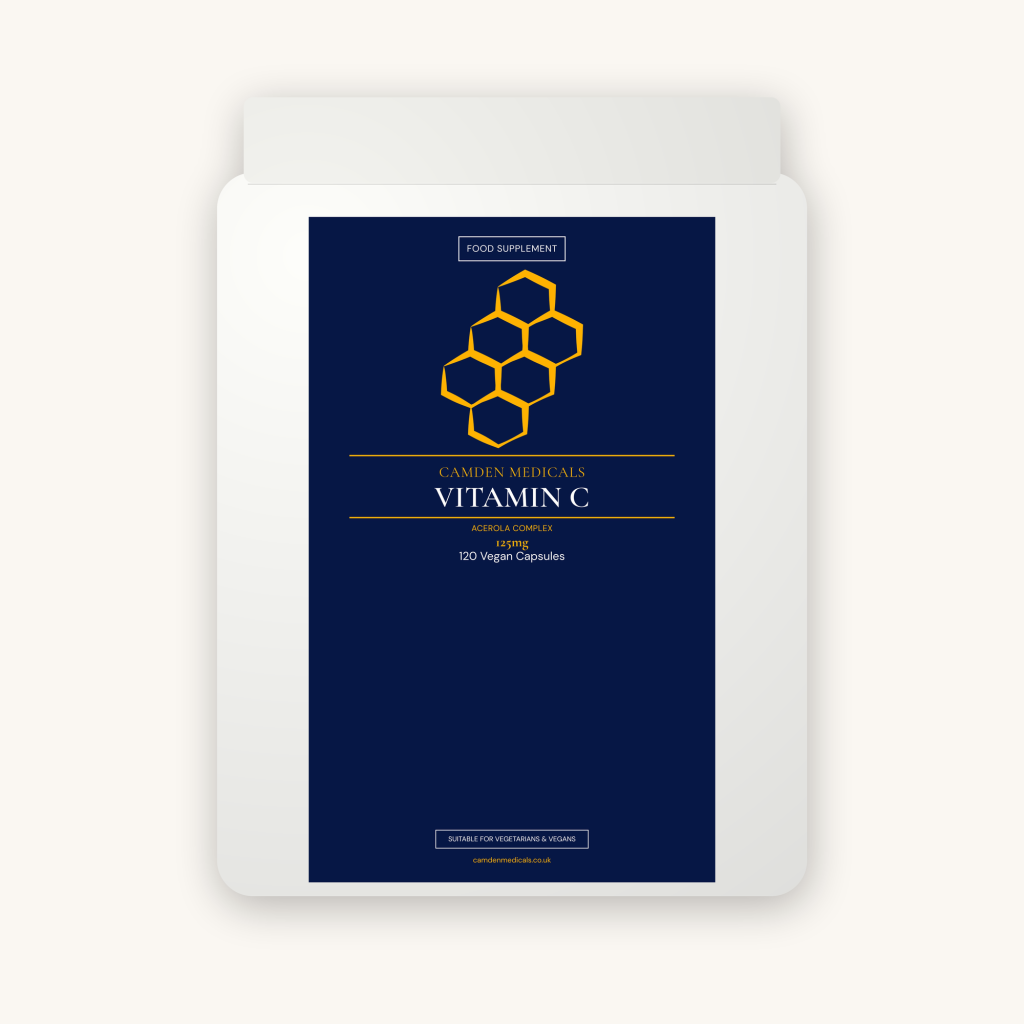
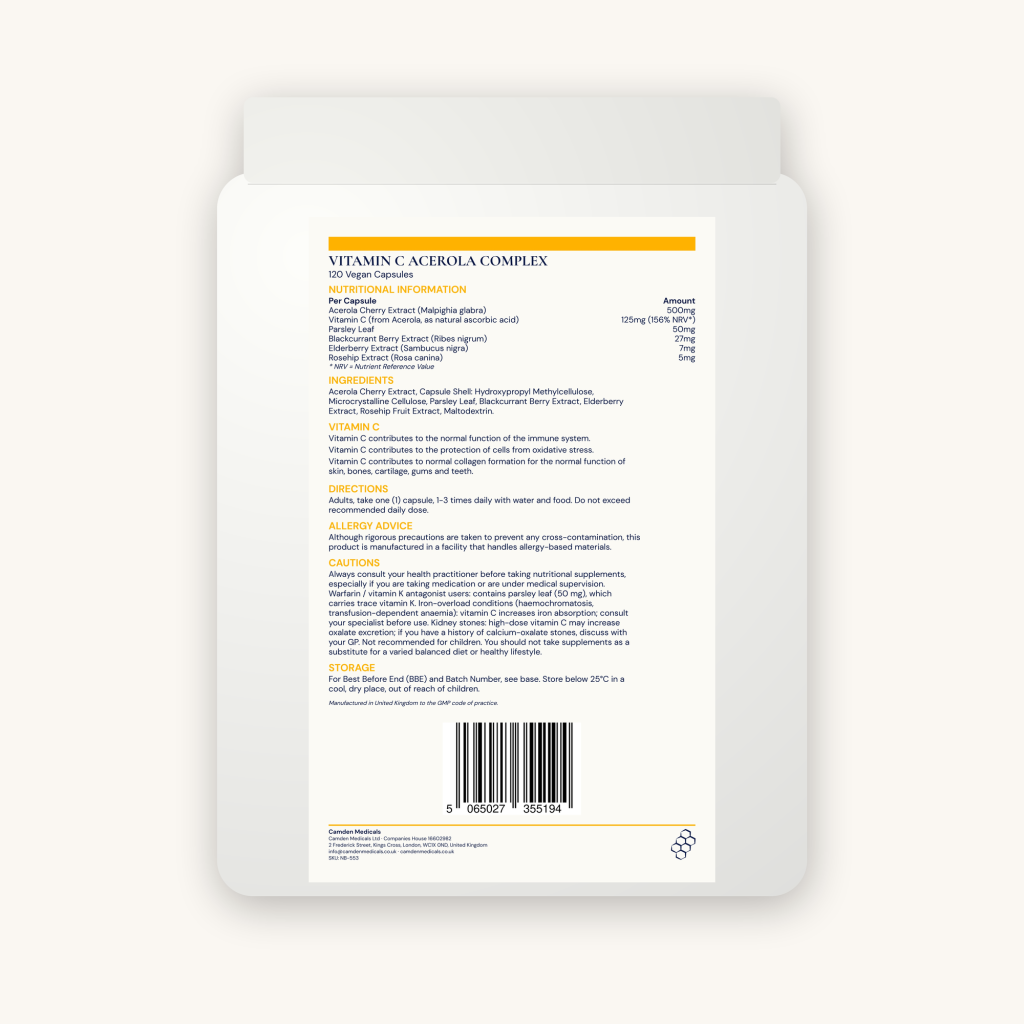
Vitamin C Acerola Immune Complex provides 125mg of vitamin C per capsule from a 500mg acerola cherry extract (Malpighia glabra), paired with parsley, blackcurrant, elderberry and rosehip extracts at adjunct doses. The 125mg per capsule represents 156% NRV, triggering all 14 UK-authorised vitamin C health claims. 120 capsules per bottle — a 4-month supply at one capsule daily.
Per 1-capsule serving
- Acerola Cherry Extract (Malpighia glabra) — 500mg, providing Vitamin C 125mg (156% NRV)
- Parsley Leaf — 50mg
- Blackcurrant Berry Extract (Ribes nigrum, 4:1) — 27mg whole-berry equivalent
- Elderberry Extract (Sambucus nigra) — 7mg whole-fruit equivalent
- Rosehip Extract (Rosa canina, 20:1) — 5mg whole-fruit equivalent
UK-authorised health claims (vitamins & minerals)
- Vitamin C contributes to the normal function of the immune system, the protection of cells from oxidative stress, the reduction of tiredness and fatigue, normal collagen formation for the normal function of blood vessels, bones, cartilage, gums, skin and teeth, normal functioning of the nervous system, normal psychological function, normal energy-yielding metabolism, the regeneration of the reduced form of vitamin E, and increases iron absorption
Key features
- 125mg Vitamin C per capsule (156% NRV) — triggers all 14 UK-authorised vitamin C health claims
- Vitamin C sourced from acerola cherry extract, paired with botanical co-factors
- 120 capsules · 4-month supply at 1/day · vegan & vegetarian
- UK-manufactured to GMP standard
How to take: Adults, take one (1) capsule, 1–3 times daily with water and food. Do not exceed recommended daily dose.
Manufactured in the United Kingdom to GMP standards.
About the ingredients
Acerola
Acerola (Malpighia glabra), also called the Barbados or West Indies cherry, is a small tropical fruit with one of the highest vitamin C contents of any food by weight. Acerola fruit powder is widely used in supplements as a natural source of vitamin C. Read more in the encyclopaedia
Blackcurrant (Ribes nigrum)
Blackcurrant (Ribes nigrum) is the small dark-purple berry of a cool-climate European shrub, widely grown in the UK, Poland, and New Zealand and best known to British consumers as the blackcurrant in Ribena and in jams and cordials. It is naturally rich in vitamin C and in anthocyanin polyphenols, and is one of the most thoroughly catalogued berries in UK horticulture. Camden uses blackcurrant as a small supporting active in NB-553 (Vitamin C Acerola gummy), where the authorised UK vitamin C health claims attach to the combined vitamin C content rather than to the blackcurrant itself.
Three practical things to know:
1. <strong>Blackcurrant is a food, and a vitamin C source.</strong> The UK Great Britain Nutrition and Health Claims Register lists no blackcurrant-specific health claims; the authorised vitamin C claims apply when a product's vitamin C content reaches 15% NRV per portion, regardless of source.
2. <strong>Eye-health and sports-recovery framings are not authorised UK claims.</strong> A New Zealand research programme around the CurraNZ blackcurrant extract has reported effects on cognitive performance, exercise recovery, and ocular blood flow in short trials. The evidence base is small, concentrated on a specific commercial preparation, and EFSA's botanical-claim evaluation is on hold — so these framings cannot be presented as authorised claims on a UK food-supplement product.
3. <strong>Blackcurrant seed oil is a different product class.</strong> Blackcurrant seed oil is the gamma-linolenic acid (GLA) source sometimes sold as a fatty-acid supplement (alongside evening primrose and borage oils). It is not the same as a blackcurrant berry extract and is covered separately in supplement evidence discussions. Read more in the encyclopaedia
Elderberry (Sambucus nigra, Black Elder)
Elderberry (Sambucus nigra, or black elder) is a small European tree whose dark-purple ripe berries are widely used in traditional cold-and-flu remedies — Sambucol syrup is the most-recognised UK brand, with own-brand and own-label products in most pharmacies and supermarkets. Camden uses elderberry as an adjunct in NB-1284 (our Vitamin Gummy with Elderberry), where the authorised UK health claims attach to the vitamin C, zinc, and selenium content — not to the elderberry itself.
Three practical things to know:
1. <strong>Modest cold-and-flu symptom signal in trials.</strong> The Hawkins 2018 meta-analysis (PMID 30670267, 4 RCTs n=180) reported that black elderberry "substantially reduced upper respiratory symptoms" with a large mean effect size — but the total trial population is small and the trials are heterogeneous, so the certainty is low. The small Zakay-Rones syrup trials in seasonal influenza are the foundational studies. UK NHS and NICE CKS Common Cold guidance uses symptomatic management (rest, hydration, paracetamol / ibuprofen) and does NOT include elderberry.
2. <strong>NEVER eat raw elderberries, leaves, stems, bark, or roots.</strong> They contain cyanogenic glycosides (sambunigrin) that produce cyanide on digestion. CDC reported a 1984 California outbreak of acute GI illness from raw elderberry juice. Commercial cooked / extracted preparations are safe; foraging and home-preparation without proper cooking is not.
3. <strong>The 2020 "cytokine storm" concern was overstated.</strong> During the early COVID-19 pandemic, some clinicians worried elderberry might worsen severe disease by triggering cytokine release. The mechanism evidence does not support a clinically significant proinflammatory effect at standard supplement doses; mainstream guidance (NIH ODS, UK BDA) does not contraindicate. People on immunosuppressants should still disclose use.
UK marketing of elderberry-only preparations cannot carry a UK Article 13.1 health claim — EFSA evaluation of botanical immune claims is on hold. Combined products like NB-1284 carry vitamin/ mineral authorised claims (vitamin C, zinc, selenium contribute to normal immune function). Camden's elderberry-as-adjunct approach is the UK-compliant route. Read more in the encyclopaedia
Parsley (Petroselinum crispum)
Parsley (Petroselinum crispum) is the familiar bright-green Mediterranean culinary herb used as a garnish, a salad ingredient (tabbouleh), and a finishing herb across European, Middle Eastern, and North African cooking. At normal culinary doses — chopped into salads, sauces, and stews — parsley is a vitamin K-rich, vitamin C-bearing food contributing to a varied diet. Camden uses parsley leaf as a small supporting active in NB-553 (Vitamin C Acerola gummy) where the authorised UK vitamin C health claims attach to the combined vitamin C content rather than to the parsley itself.
Three practical things to know:
1. <strong>Parsley leaf at food and supplement doses is not parsley essential oil.</strong> The leaf is a normal food. Concentrated parsley essential oil (high apiole + myristicin) has historical use as a high-dose emmenagogue and has caused fatalities at overdose levels. Food-supplement-tier parsley powder is not the essential oil.
2. <strong>Parsley is a vitamin K-rich food.</strong> If you take warfarin, your dietitian and anticoagulation clinic want a stable weekly vitamin K intake — sudden large increases or decreases in parsley (or any green leafy intake) can affect INR. Talk to your anticoagulation clinic before changing intake significantly.
3. <strong>Pregnancy: culinary intake fine, supplement-extract caution.</strong> Eating parsley as a food during pregnancy is not a concern. High-dose parsley extract supplements are best avoided in pregnancy, and parsley essential oil is contraindicated in pregnancy. Talk to your midwife or pharmacist before starting any new supplement during pregnancy. Read more in the encyclopaedia
Rosehip (Rosa canina)
Rosehip is the small red-orange fruit of the wild dog rose, Rosa canina, used for centuries across Northern and Eastern Europe as a tea, jam, syrup, and traditional remedy. It is best known as one of the highest natural sources of vitamin C in the European diet — a 100 g serving of fresh rosehip can deliver several times the NHS-RNI for vitamin C, though most processing and drying reduces that figure substantially. Camden uses rosehip as a small supporting active in NB-553 (Vitamin C Acerola gummy), where the authorised UK vitamin C health claims attach to the combined vitamin C content rather than to the rosehip itself.
Three practical things to know:
1. <strong>Rosehip is a food, not a medicine.</strong> The UK Great Britain Nutrition and Health Claims Register lists no rosehip- specific health claims. The body of joint-pain literature behind standardised extracts like Litozin® and i-flex® is small and uses a specific preparation — generic rosehip powder is not the same thing in evidence terms.
2. <strong>Vitamin C content varies widely.</strong> Fresh rosehip can contain 200-2000 mg vitamin C per 100 g depending on cultivar, ripeness, and region. Drying and standardisation reduce that to typical extract values of 0.5-3% by weight. The label's vitamin C declaration is what matters for the authorised health claim — not the milligrams of rosehip powder.
3. <strong>Persistent joint pain needs a GP, not a supplement.</strong> NHS pathways for osteoarthritis (exercise, weight management, topical NSAIDs, oral NSAIDs where appropriate) and rheumatoid arthritis (early DMARD referral) are time-critical. A rosehip supplement is not a substitute. If you have new, persistent, or progressive joint pain, talk to your GP or pharmacist. Read more in the encyclopaedia
Vitamin C
Vitamin C (ascorbic acid) is a water-soluble vitamin the body uses for collagen synthesis, immune function, antioxidant protection of cells, and to help absorb iron from plant foods. UK NHS reference intake is 40 mg/day for adults. Most UK adults meeting the eat-five-a-day pattern cover this from food; supplementation is sensible for those who do not, and during specific situations like recovery or pregnancy. Read more in the encyclopaedia